Building defects
In short: Brick ties, or wall ties, are usually metal connectors that hold the outer brick leaf of a cavity brick or brick veneer wall to the inner leaf or frame. Research suggests they corrode worst where they enter the outer leaf's mortar, often unseen until a wall fails. Signs include horizontal bed-joint cracks and bulging. UK guidance describes drilling in new stainless steel ties, specified by a structural engineer.
Key takeaways
- Brick ties carry wind and earthquake loads from the outer brick leaf to the inner leaf or frame; failed ties have let outer leaves detach.
- NCC Housing Provisions: new homes within 1 km of breaking surf or 100 m of salt water need Grade 316L stainless or engineered polymer ties.
- Corroded ties often show no sign until a wall fails, so checking them may mean a borescope camera or taking bricks out.
- After the 1989 Newcastle earthquake, tie corrosion was found to be widespread, and worst in exposed southern walls and buildings close to the coast.
Seeing horizontal cracks or a bulge in your brickwork? Send photos of the wall through our quote page or call 02 4091 1900.
What do brick ties do in cavity brick and brick veneer walls?
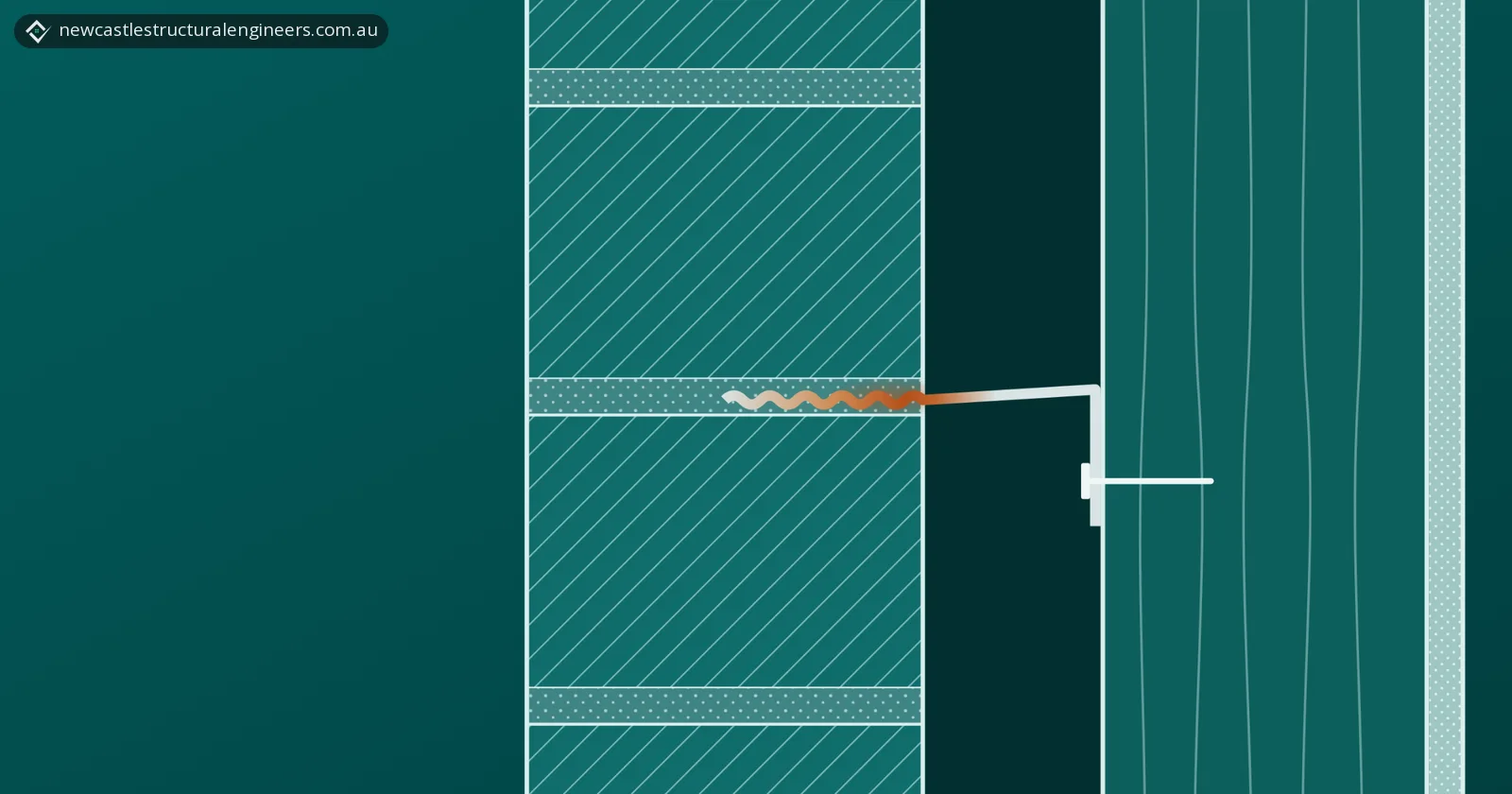
Brick ties, also called wall ties, are usually metal connectors that hold the outer leaf of brickwork to the inner brick leaf in a cavity brick wall, or to the frame in a brick veneer wall. University of Newcastle researchers (Terry and colleagues, 2023) explain that ties transfer lateral loads, acting at right angles to the wall, to the internal frame, while allowing some movement in the plane of the wall. Where ties have failed under high earthquake or wind loads, the outer leaf has been found to detach completely.
For new houses, the National Construction Code (NCC) sets tie rules in Part 5.6 of the ABCB Housing Provisions, published by the Australian Building Codes Board (ABCB). Part 5.6 applies to buildings in areas with a wind class of not more than N3, among other limits. Under NCC 2022, the rules for the two wall types are:
| Cavity brick | Brick veneer | |
|---|---|---|
| What the tie connects | Outer brick leaf to the inner brick leaf | Outer brick leaf to the frame, commonly timber |
| Minimum tie duty | Light duty cavity ties where the design wind speed is N1; medium duty above N1 | Light duty veneer ties where the design wind speed is not more than N2; medium duty above N2 |
| Maximum tie spacing | 600 mm horizontally and 600 mm vertically | 450 mm horizontally and 600 mm vertically with 450 mm stud spacing; 600 mm and 400 mm with 600 mm stud spacing |
| Embedment | At least 50 mm into each masonry leaf | At least 50 mm into the masonry leaf |
Part 5.6 also says ties must be installed so that moisture can't travel along them to the inner leaf or the frame.
Why do brick ties corrode?
Brick ties corrode when moisture, and near the coast salt, attacks the steel inside the wall, and research suggests the worst corrosion is often hidden where the tie meets the outer leaf's mortar. Chaves and colleagues (University of Newcastle, 2022) say field observations suggest the most serious corrosion occurs at the inner face of the outer leaf, and sometimes within the mortar itself. Three things can make it worse:
- Carbonated mortar. Carbonation lowers the pH of mortar from 12–13 to 8–9 or below, which can start corrosion of embedded steel (Terry and colleagues, 2025).
- Poor cavity drainage. The 2023 paper reports expert opinion that poor cavity drainage likely makes coastal tie corrosion more severe. In a brick veneer retaining wall at a school in Wyoming, NSW, the researchers found fractured ties alongside blocked ventilation and drainage, and mould on the outer leaf.
- Old, unprotected ties. Uncoated mild steel ties were likely used in many structures built before galvanised and stainless steel ties were standardised in Australia in 1977 (Terry and colleagues, 2025).
Are brick ties near the Newcastle coast at greater risk?
Yes, the evidence points that way: the NCC calls for more corrosion-resistant ties near surf and salt water, and Newcastle observations found tie corrosion worst close to the coast. The 2023 University of Newcastle paper reports that after the 1989 Newcastle earthquake, Melchers and Page found most partial failures of structures related to masonry, including veneer and cavity walls with corroded or missing ties. Tie corrosion was widespread, and worst in exposed southern walls and in buildings close to the coast. Our guide to the 1989 Newcastle earthquake covers its wider damage to older masonry buildings.
In August 2023, the university's researchers built a small brick veneer house and a cavity brick house at a severe marine corrosion site in Belmont, less than 250 m from breaking surf. After one year, uncoated mild steel ties lost more in the east wall, which takes the most sea salt spray, and the slower-drying south wall than in the north wall (Terry and colleagues, 2025).
What are the signs of brick tie corrosion?
The main signs of brick tie corrosion are horizontal cracks along mortar bed joints and a bulging outer leaf, but corroded ties may show nothing at all. Terry and colleagues (2025) say corrosion of embedded ties is difficult to detect, and often only becomes apparent after the wall has failed or been demolished. UK guidance from LABC Warranty describes the signs:
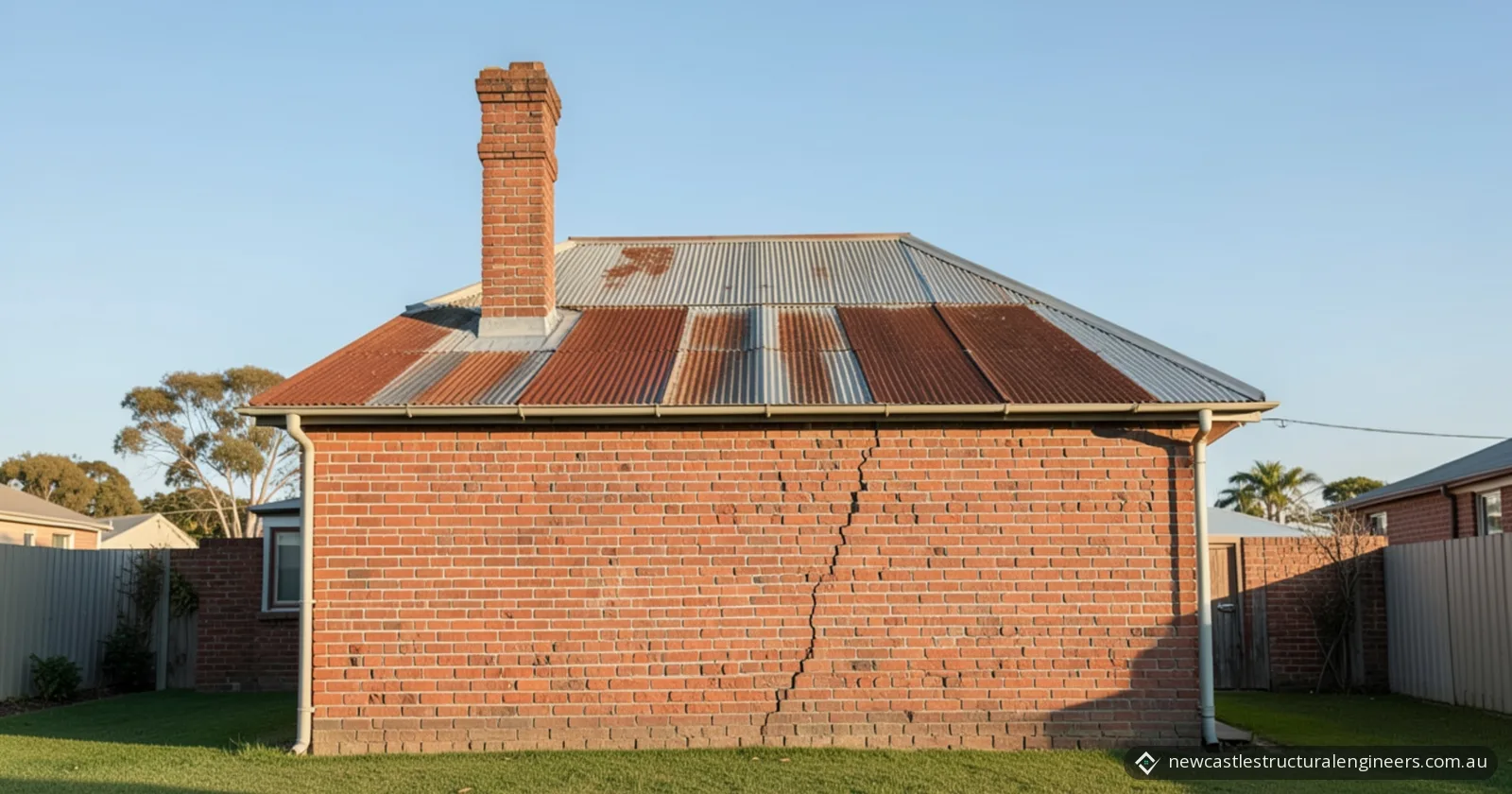
- Horizontal cracks at tie courses. Rust takes up more volume than steel, forcing apart the bricks above and below the bed joint, so cracks line up with the tie positions. Joints repointed in the past may show as thicker bed joints at regular intervals.
- Bulging. A bulging external cavity wall can also indicate tie failure.
- No visible sign. Lightweight butterfly wire ties can corrode right through with almost no external symptoms; heavier fishtail and vertical twist ties expand enough to split the mortar.
Bulging can have other causes. In our Kotara inspection, a subfloor brick wall and its engaged piers were bulging under earth pressure and surcharge from an adjacent pool and pebblecrete structure.
How are brick ties checked?
Brick ties are checked by locating them and then looking at them directly, through a small hole with a borescope camera or by taking bricks out. LABC Warranty says a bulging wall should be explored by opening it up or with a borescope. Chaves and colleagues (2022) note that ties in a closed cavity, spread across the whole wall, are difficult to inspect individually or in large enough numbers for a structural assessment.
A borescope shows the tie in the cavity, but not the length bedded in mortar, where the 2023 paper notes ties can suffer localised corrosion. To measure corrosion in the Belmont test houses, researchers removed whole bricks from the cavity brick walls, and unscrewed veneer ties from the timber frame (Terry and colleagues, 2025).
How are corroded brick ties replaced?
Corroded brick ties can be replaced by drilling in new stainless steel remedial ties, staggered from the old ones, and then treating the old ties so they can't keep cracking the brickwork. UK guidance from LABC Warranty sets out this method:
- Locate the existing ties.
- Insert proprietary stainless steel remedial ties into drilled holes, staggered from the originals, and fix them to both leaves with chemical or mechanical anchors.
- Treat the old ties, except butterfly wire ties, because rusting old ties can still damage the masonry.
- Consider repointing, which enhances the wall's stability.
In brick veneer, the new tie has to reach the frame. Simpson Strong-Tie, a US manufacturer, describes driving its stainless steel helical tie through a pilot hole into the backing, including timber studs, then repointing the hole; it says site pull tests are often used to verify performance. LABC Warranty says remedial tie work should be specified and supervised by a structural engineer.
What rules apply to brick ties in NSW?
In NSW, new houses that follow the NCC 2022 ABCB Housing Provisions use Part 5.6, which requires ties to comply with AS 2699.1 and sets their minimum corrosion protection by exposure. A house designed to AS 3700, or to AS 4773.1 and AS 4773.2, follows those standards instead. The NSW Government says NSW will adopt NCC 2025 on 1 May 2027; the NCC 2025 version of Part 5.6 has the same exposure table.
| Exposure condition (Table 5.6.5d) | Minimum tie corrosion protection |
|---|---|
| Less than 1 km from breaking surf; less than 100 m from salt water not subject to breaking surf; or within heavy industrial areas | Grade 316L stainless steel, or engineered polymer complying with AS 2699.1 |
| 1 km to less than 10 km from breaking surf; or 100 m to less than 1 km from salt water not subject to breaking surf | Sheet steel and bar ties galvanised after manufacture, 470 g/m² on each side; galvanised wire ties, 470 g/m² coating mass; or Grade 304L stainless steel |
| All other areas | Galvanised sheet steel, 300 g/m² coating on each side; or sheet steel ties galvanised after manufacture, 300 g/m² on each side |
The NCC adds that ties suitable for a more severe exposure can also be used in a less severe one. Which row applies to a Hunter home depends on the site, so ask an engineer or certifier to confirm it.
One caution comes from Chaves and colleagues (2022). In short-term, artificially accelerated laboratory tests, Grade 316 stainless steel ties lost the least mass overall in the most commonly used modern cement mortar, but relatively more strength than galvanised ties, through localised corrosion at the mortar–cavity interface. The researchers suggest some concern about recommending stainless steel ties for aggressive marine exposure.
Approval for repairs. A NSW Department of Planning and Environment fact sheet on the State Environmental Planning Policy (Exempt and Complying Development Codes) 2008 lists masonry repairs as remedial building work. Minor building alterations are considered exempt development if they don't permanently alter load-bearing capacity, reinstate the element's intended structural capacity, are like-for-like and have minimal impact. Exempt work doesn't apply to heritage items or heritage conservation areas, and work that isn't exempt may be complying development or need a development application. The fact sheet doesn't name wall ties, so don't assume a tie replacement is exempt: confirm the approval pathway with the council or a certifier before work starts.
Newcastle heritage areas. The City of Newcastle's Development Control Plan, Section E2, covers nine heritage conservation areas, including Cooks Hill, The Hill and Newcastle East. For each, it lists exposed face brick of existing building facades among the elements to preserve or sensitively restore.
When to call a structural engineer
Call a structural engineer when brickwork shows horizontal cracks along bed joints, bulges, or exposes rusted ties, and before anyone installs remedial ties. Book an inspection if:
- horizontal cracks repeat at regular heights up a brick wall;
- an outer brick leaf bulges or leans;
- you're buying an older brick home, especially near the coast.
Our structural inspections are for homeowners concerned about cracking or movement and for buyers, with a written report and practical options. Where new ties need specifying, our structural design service covers remedial design for repairs to existing structures. Corrosion is also among the common structural issues found during inspections.
Frequently asked questions
How long should brick ties last?
University of Newcastle researchers note that current Australian standards, AS 3700 and AS 2699.1, expect a wall tie to last for the lifetime of the structure, which is typically 50 years for masonry structures.
Do galvanised brick ties rust quickly near the beach?
Not in the first year of one local study. In the University of Newcastle's Belmont test houses, galvanised ties inside the wall cavities showed negligible corrosion losses after one year, while uncoated mild steel ties showed notable losses. The researchers suggest the cavity gives some protection, and expected clearer trends for the galvanised ties after two years.
Are polymer (plastic) wall ties a good replacement?
It depends on the loads. The NCC 2022 Housing Provisions accept engineered polymer ties that comply with AS 2699.1 for new houses, even in the most severe exposure. But University of Newcastle researchers note that where demands for lateral stability and capacity are high, polymer ties can't provide the required capacity, so the tie choice is an engineering decision.
Sources
- Australian Building Codes Board: NCC 2022 ABCB Housing Provisions, Part 5.6 Masonry components and accessories
- Australian Building Codes Board: NCC 2022 Volume Two, Part H1 Structure (H1D5 Masonry)
- Australian Building Codes Board: ABCB Housing Provisions Standard 2025, Part 5.6 Masonry components and accessories
- NSW Government: NSW to adopt new National Construction Code in May 2027 (25 March 2026)
- NSW Department of Planning and Environment: Remedial building work, State Environmental Planning Policy (Exempt and Complying Development Codes) 2008, fact sheet (2023)
- City of Newcastle: Development Control Plan, Section E2 Heritage conservation areas
- Terry, Chaves, Masia and Melchers, The University of Newcastle: Corrosion of steel wall ties within brick masonry cavity and veneer walls, Australasian Corrosion Association Conference (2023)
- Terry, Chaves, Masia, Hossain and Melchers, The University of Newcastle: The corrosion of steel wall ties within cavity brick and brick veneer wall air cavities, 15th Canadian Masonry Symposium (2025)
- Chaves, Melchers, Jardim do Nascimento, Philips and Masia, The University of Newcastle: Effects of inter-cavity corrosion on metallic wall ties in masonry structures, AIMS Materials Science (2022)
- LABC Warranty (UK): Technical update, Wall tie replacement in existing buildings (2020)
- Simpson Strong-Tie (US): Anchor Anatomy 101, Heli-Tie helical wall tie