Ground conditions
In short: Acid sulfate soils are natural sediments containing iron sulfides that form sulfuric acid when dug up or drained, and the acid can corrode concrete and steel. City of Newcastle says they typically lie in low-lying coastal land, generally less than 5 m above mean sea level. Most NSW local environmental plans map them in five classes; works on mapped land may need a management plan.
Key takeaways
- Disturbed acid sulfate soils form sulfuric acid, which the NSW environment department says can corrode concrete, iron, steel and some aluminium alloys.
- The Newcastle Local Environmental Plan 2012 maps five classes of land; on Class 1 land, any works may need a management plan or preliminary assessment.
- City of Newcastle counts disturbing more than one tonne of soil, and building footings or foundations, as works under its acid sulfate soils rules.
- In residential zones, Lake Macquarie's development control plan requires a preliminary acid sulfate soil assessment with the development application where disturbing these soils is unavoidable.
- AS 2870, AS 3600 and AS 2159 each have a clause on aggressive or acid sulfate soils, covering footings, concrete and piles.
Building on low-lying land in the Hunter? Get a quote or call 02 4091 1900, and send us your plans and any soil report.
What are acid sulfate soils?
Acid sulfate soils are natural sediments containing iron sulfides, which react with oxygen to form sulfuric acid when the soil is dug up or drained. Left undisturbed, they do not present any risk, according to the NSW Department of Climate Change, Energy, the Environment and Water (DCCEEW).
City of Newcastle describes two kinds: actual acid sulfate soils, which are already producing acid, and potential acid sulfate soils, which could become acid-producing once disturbed.
The amount of acid can be large. The NSW Acid Sulfate Soil Manual (1998) says that for every tonne of pyrite (an iron sulfide) completely oxidised, 1.6 tonnes of pure sulfuric acid is produced.
Where are acid sulfate soils found in Newcastle and the Hunter?
City of Newcastle says acid sulfate soils are typically found in low-lying areas near the coast, generally where the surface is less than 5 m above mean sea level, and that parts of the Newcastle local government area are affected. DCCEEW says they occur in every coastal estuary in NSW, usually below about 1 m above sea level, and lists the Hunter River as a notable location.
Council documents give two Hunter examples:
- Carrington: City of Newcastle's Carrington Greenspace Masterplan (December 2020) notes that Throsby Creek is mapped Class 1, and the majority of the suburb's residential, open space and industrial land is mapped Class 2.
- Belmont: Lake Macquarie City Council's Development Control Plan 2014 (DCP) says the Belmont town centre is located on Class 2, 3 and 5 acid sulfate soils.
To check a property, look up its local environmental plan (LEP) acid sulfate soils map in the NSW Planning Portal Spatial Viewer. DCCEEW's 1:25,000 risk maps on eSPADE also show the estimated depth to acid sulfate soil. A map is not a test result: the Manual notes that the maps do not describe how severe the soils actually are. Our guide to mine subsidence in Newcastle covers another ground condition to check before building.
How do acid sulfate soils affect footings, concrete and steel?
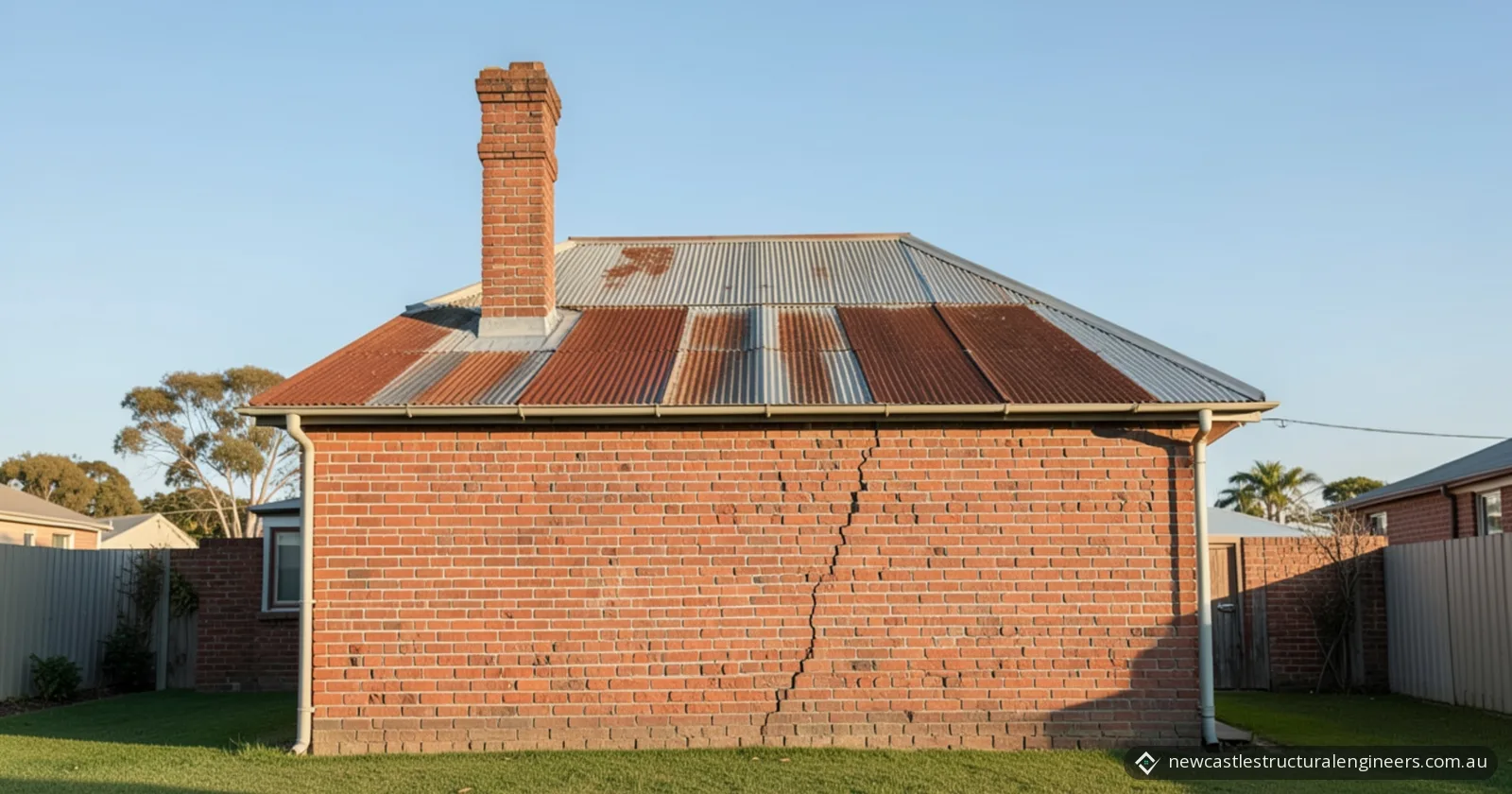
Disturbed acid sulfate soils can corrode concrete and steel, and potential acid sulfate clays can subside under load. DCCEEW says sulfuric acid can corrode concrete, iron, steel and some aluminium alloys. The NSW Acid Sulfate Soil Manual says:
- where floodplain soil is dug up and used as fill for house slabs, the acid may corrode the slab and footings, and attack water and sewerage pipes;
- acid sulfate soils can affect the type of concrete or steel required, and the design of buildings;
- potential acid sulfate clays hold 70 to 80% water by volume and are gel-like, so loading them causes subsidence.
Sites with soft soils, such as soft clay or silt, fall under Class P in the general site class definitions of the National Construction Code (NCC) 2022 Housing Provisions. For a Class P site, the Housing Provisions refer designers to AS 2870 for design and construction.
Groundwater matters too. The Manual's assessment guidelines say dewatering major construction sites on land mapped Class 1 to 3 on the acid sulfate soils planning maps of the 1998 Manual can be assumed to affect acid sulfate soils.
| Building element | Risk named in NSW sources | Australian Standard clause |
|---|---|---|
| Slabs and footings | The acid may corrode the slab and footings (Manual) | AS 2870-2011, 5.5 Requirements in aggressive soils |
| Concrete generally | Sulfuric acid can corrode concrete (DCCEEW) | AS 3600:2018, 4.8.1 Sulfate and acid sulfate soils |
| Concrete piles | Constraints to consider include "foundations of buildings … pier and bridge pylons" (Manual) | AS 2159-2009, 6.3 Acid sulfate soils; 6.4.2 Exposure classification for concrete piles |
| Steel piles | Sulfuric acid can corrode steel (DCCEEW) | AS 2159-2009, 6.5.2 Exposure classification for steel piles |
| Soft clay and fill | Potential acid sulfate clays can subside under load (Manual) | NCC 2022: Class P sites refer to AS 2870 |
AS 2870's aggressive soils clause covers isolating concrete from the ground, and concrete strength and detailing.
How can you tell if a site has acid sulfate soils?
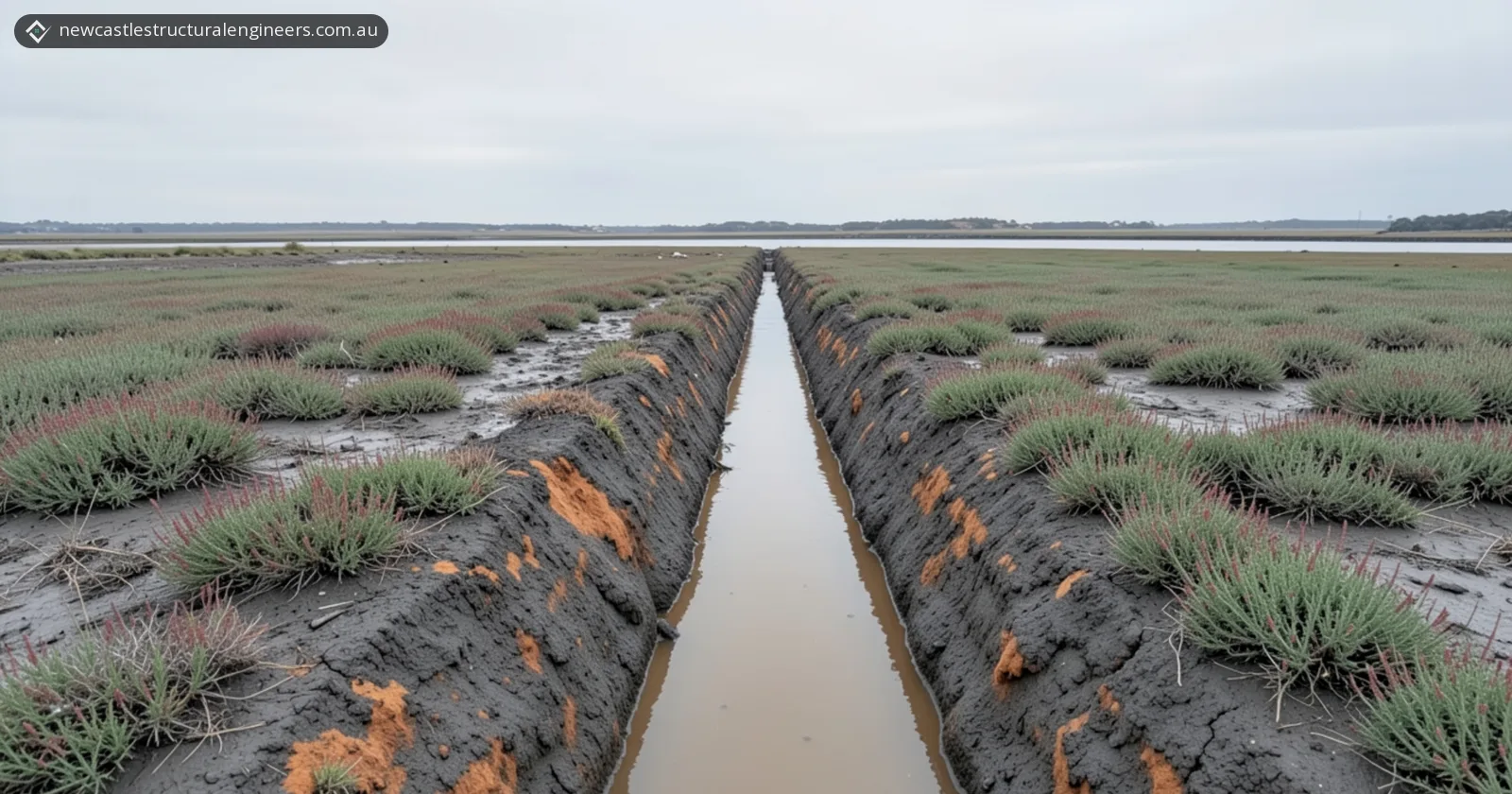
You can't always tell by looking, so start with the LEP map and confirm with soil testing. The Manual's signs of actual acid sulfate soils include soil with a pH below 4, drain water below pH 5.5 that is unusually clear or milky green, rust-coloured iron stains or ochre, butter-coloured jarosite, and corroded concrete or steel. Potential acid sulfate soils, typically waterlogged grey estuarine sands, silty sands or soft, buttery clays, may show none of these signs. The Manual's urban development guidelines say to sample to at least the depth of the proposed excavation, or of the estimated drop in the water table if groundwater is likely to be disturbed, to take at least five samples in any one area, and to always confirm conclusions with laboratory analysis. For a full sampling program, its assessment guidelines say the investigation should usually go at least 1 m beyond the excavation or the estimated drop in the water table, or at least 2 m below the land surface, whichever is greater.
What are the acid sulfate soils rules in Newcastle and the Hunter?
Most NSW LEPs, including Newcastle's, have an acid sulfate soils clause tied to a five-class map; in Newcastle it is clause 6.1 of the Newcastle LEP 2012. The class of land and the depth of the works decide the trigger:
| Class | Where acid sulfate soils are likely (NSW fact sheet) | Works that may need a plan or preliminary assessment before consent (City of Newcastle) |
|---|---|---|
| 1 | On and below the natural ground surface | Any works |
| 2 | Below the natural ground surface | Works below the ground surface, or likely to lower the water table |
| 3 | More than 1 m below the natural ground surface | Works more than 1 m below natural ground, or lowering the water table more than 1 m below it |
| 4 | More than 2 m below the natural ground surface | Works more than 2 m below natural ground, or lowering the water table more than 2 m below it |
| 5 | Not typically found, but within 500 m of Class 1 to 4 land | Works within 500 m of adjacent Class 1 to 4 land below 5 m AHD (Australian Height Datum), likely to lower its water table below 1 m AHD |
City of Newcastle defines works to include disturbing more than one tonne of soil, building drains, and constructing footings or foundations. Where development consent is required, Council says consent may not be issued without an acid sulfate soils management plan prepared under the Manual. A plan may not be required if a preliminary assessment under the Manual shows one is not needed. The Newcastle Development Control Plan 2023, Section C5, says the plan should describe measures against the soils' effects on the works, including engineering and landscaping issues, and on the environment.
Lake Macquarie DCP 2014, Part 3 Development within Residential Zones, section 2.6, says development must be sited or designed to avoid disturbing acid sulfate soils. Where disturbance is unavoidable, a preliminary assessment report must be submitted with the development application (DA). If it identifies potential adverse impacts, a detailed assessment report and management plan must be submitted. One of the section's objectives is that built structures and infrastructure are not adversely affected.
Port Stephens and other councils: a NSW Government fact sheet says exemptions vary between LEPs, but may include works that disturb less than 1 tonne of soil and are unlikely to lower the water table. Check the council's own clause and map.
How are acid sulfate soils managed on a building site?
The NSW Acid Sulfate Soil Manual's first option is to avoid disturbing acid sulfate soils. Its other options include:
- laying out the site to avoid disturbing the soils or lowering the water table;
- covering the land with clean fill to give enough depth for foundations; on clayey or peaty ground, the Manual expects some subsidence and says pre-loading is likely to be necessary;
- neutralising with lime thoroughly mixed through the soil (the Manual warns the amounts needed may be very large);
- keeping excavated sulfidic material from oxidising, for example by placing it back below the water table.
When to call a structural engineer
Call a structural engineer when acid sulfate soils meet footings, piles or excavation, for example:
- a new home, extension, pool or retaining wall on Class 1 to 5 land, where the footings, slab and concrete must suit the soil and any management plan (see our structural design service);
- a soil report that finds acid sulfate soils, or soft estuarine clay;
- excavation or dewatering for a basement, pool or deep footing that could lower the water table;
- a house you own or are buying on low-lying land with corroded concrete or steel near the footings (see our structural inspections, including pre-purchase inspections).
Frequently asked questions
How much soil is one tonne?
It depends on the soil's density. The NSW Acid Sulfate Soil Manual says to divide the weight by the bulk density, which can range from 0.7 to 2.0 tonnes per cubic metre and be as low as 0.2 for peats, so one tonne is about 0.5 to 1.4 cubic metres on that range. Its liming tables assume 1 tonne per cubic metre.
Who should do the soil sampling for acid sulfate soils?
The NSW Acid Sulfate Soil Manual recommends that qualified consultants do the sampling, and that a laboratory analyses the samples using the methods in the Manual.
What rules apply to acid sulfate soil taken off site?
The NSW Environment Protection Authority's Waste Classification Guidelines (2014) apply to acid sulfate soils that need to be transported and treated off site, according to the NSW environment department.
Are acid sulfate soils harmful to touch?
They can be. The NSW environment department says acid sulfate soil and water can irritate your skin and eyes, and that drinking acidic water may make animals ill.
Is the 1998 NSW manual still the guide for acid sulfate soils?
Yes, alongside newer national guidance. The NSW environment department says national guidance on sampling, laboratory methods, dewatering, dredging and monosulfidic black oozes supplements, but does not replace, the NSW Acid Sulfate Soil Manual (1998).
Sources
- NSW Department of Climate Change, Energy, the Environment and Water: Acid sulfate soils
- Acid Sulfate Soils Management Advisory Committee: NSW Acid Sulfate Soil Manual (1998), hosted by the NSW EPA
- NSW Government, Marine Estate Management Strategy: Fact sheet, Development affecting acid sulfate soils in coastal floodplains
- City of Newcastle: Acid Sulfate Soils
- City of Newcastle: Newcastle Development Control Plan 2023, Section C5 Soil management
- City of Newcastle: Carrington Greenspace Masterplan (December 2020)
- Lake Macquarie City Council: Development Control Plan 2014, Part 3 Development within Residential Zones (Revision 39)
- Lake Macquarie City Council: Development Control Plan 2014, Part 10 Town Centre Area Plans, Belmont
- Australian Building Codes Board: NCC 2022 Housing Provisions, Part 4.2 Footings, slabs and associated elements
- Standards Australia: AS 2870-2011 Residential slabs and footings
- Standards Australia: AS 3600:2018 Concrete structures
- Standards Australia: AS 2159-2009 Piling, Design and installation